
Quick Answer: Effective office cleaning in Hertfordshire for hybrid teams requires transitioning from static schedules to footfall-based zonal cleaning. Focus resources on high-traffic areas and high-touch point disinfection (HTP) during peak mid-week periods. Implementing a 'Clean Desk Policy' and using BS EN 1276 compliant chemicals ensures a hygienic environment that reduces absenteeism and supports workplace safety regulations.
The Evolution of the Hertfordshire Office Environment
The traditional five-day office week is no longer the standard for many businesses across Hertfordshire and Bedfordshire. While the shift to hybrid working has offered flexibility for employees, it has created a significant challenge for facility managers and business owners: the cleaning schedule is often out of sync with actual footfall. Most office cleaning contracts are static, providing the same level of service on a Tuesday when the office is at 90% capacity as they do on a Friday when it might be at 10%. This leads to two specific problems: wasted budget on empty rooms and insufficient hygiene in high-traffic zones during peak mid-week periods.
The Real Cost of Sub-Standard Office Hygiene
Inadequate cleaning is more than an aesthetic issue; it is a financial one. According to the Health and Safety Executive (HSE), millions of working days are lost annually in the UK due to work-related illness. In an office environment, viruses and bacteria spread rapidly through high-touch points like door handles, lift buttons, and shared kitchen appliances. When cleaning is neglected, or performed with a 'surface-level' approach, the rate of cross-infection increases. This results in 'presenteeism'—where staff are working but at reduced capacity due to illness—and increased absenteeism, both of which directly impact your bottom line.
Why Generic Cleaning Schedules Fail Hybrid Teams
If your cleaning team follows a rigid checklist regardless of who is in the building, you are likely overpaying for low-impact tasks and under-investing in high-risk areas. For example, vacuuming a boardroom that wasn't used on a Thursday is a waste of resource, whereas the kitchen and washrooms used by a full team on a Wednesday may require a double-cycle of disinfection that a standard contract doesn't provide. Effective office cleaning in Hertfordshire now requires a 'zonal' approach, focusing resources where the people actually are.
The Foundations of an Effective Office Cleaning Strategy
To move away from generic filler service and toward a strategy that protects your staff and your investment, you must focus on the following core pillars of commercial hygiene.
1. High-Touch Point Disinfection (HTP)
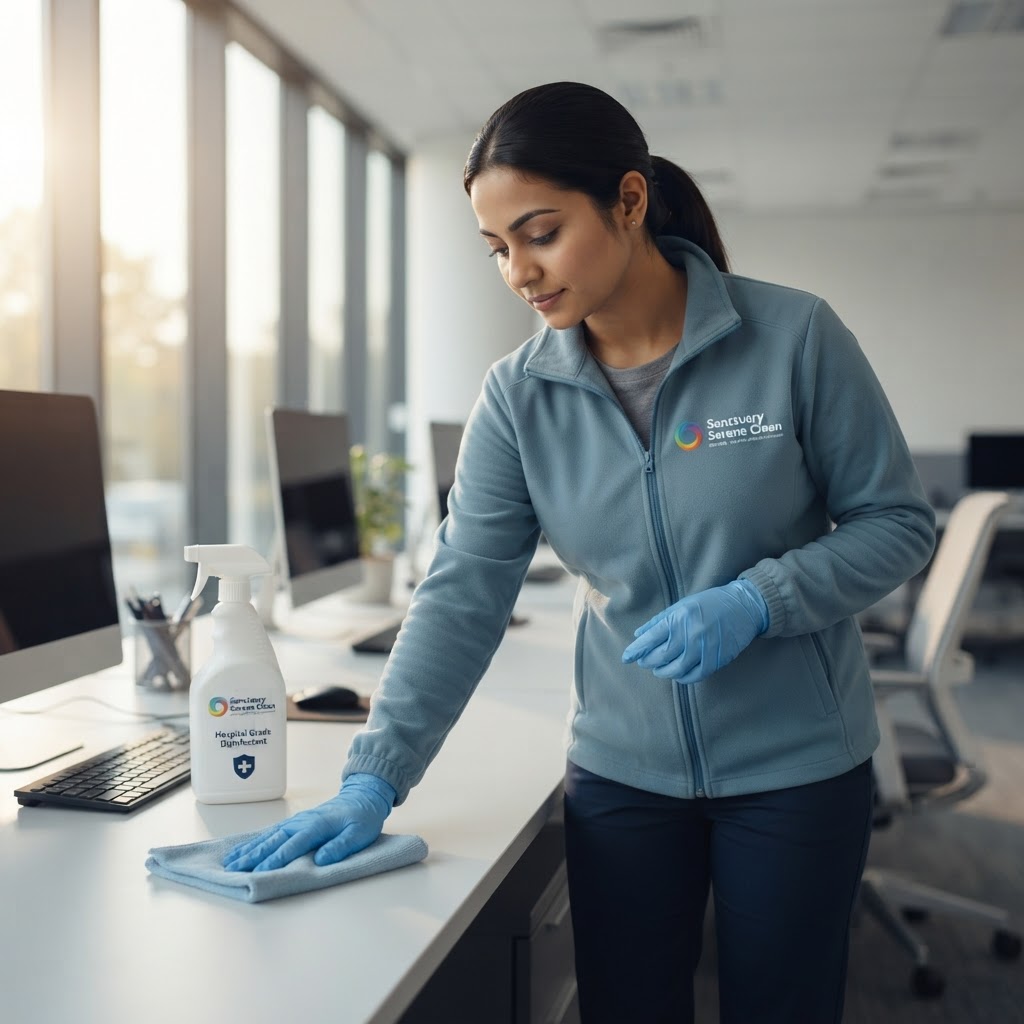
The most dangerous areas in an office aren't always the ones that look the dirtiest. A keyboard can harbour more bacteria than a toilet seat if not sanitised correctly. A professional cleaning schedule should prioritise HTPs, including light switches, kettle handles, printer buttons, and communal fridge doors. These areas require high-frequency sanitisation with BS EN 1276 or BS EN 14476 compliant chemicals to ensure they are actually germ-free, not just visually clean.
2. Hot-Desking Hygiene and the 'Clean Desk' Policy
The rise of hot-desking in Hertfordshire offices has increased the risk of cross-contamination. When multiple people use the same workstation throughout the week, the build-up of skin cells, food particles, and microbes is accelerated. We recommend implementing a 'Clean Desk Policy' where staff clear their stations at the end of the day. This allows cleaners to properly sanitise the entire surface of the desk rather than just wiping around monitors and coffee mugs. This simple operational change can reduce surface-borne bacteria by up to 90%.
3. Washroom and Kitchen Standards
Communal areas are the primary source of complaints in office environments. In Hertfordshire, where many offices are located in converted buildings or older business parks, drainage and ventilation can exacerbate hygiene issues. A professional service focuses on deep-cleaning grout, descaling taps (essential in hard water areas like Luton and St Albans), and ensuring that high-use areas like microwave interiors and sink overflows are treated with the same rigour as the front-of-house reception.
Compliance and Workplace Safety Regulations
Under the Workplace (Health, Safety and Welfare) Regulations 1992, employers have a legal duty to ensure that every workplace is kept sufficiently clean. Specifically, Regulation 9 states that 'the surfaces of the floors, walls and ceilings of all workplaces... shall be kept in a clean state.' This isn't just about appearance; it's about removing waste and ensuring that floor surfaces don't become slip hazards due to the build-up of grease or dust. Failure to maintain these standards can lead to HSE interventions or, in the event of an accident, significant liability claims.
Air Quality and Carpet Maintenance
Many offices in Hertfordshire suffer from poor Indoor Air Quality (IAQ). Carpets act as a filter, trapping dust, pollen, and pollutants. However, once a carpet reaches its 'holding capacity,' those particles are released back into the air every time someone walks across the room. This can trigger allergies and respiratory issues among staff. A robust cleaning schedule includes regular HEPA-filter vacuuming and periodic deep-extraction cleaning to remove the deep-seated grit that wears down carpet fibres and degrades air quality.
How to Audit Your Current Office Cleaning Provider
If you aren't sure if your current cleaning service is delivering value, look for these three indicators of a professional operation:
- Colour-Coded Equipment: Are they using the same cloths in the kitchen as they do in the bathrooms? A professional team uses a strict colour-coded system (typically red for toilets, blue for general areas, yellow for washroom surfaces, and green for kitchens) to prevent cross-contamination.
- Method Statements and Risk Assessments (RAMS): Does your provider have documented processes for how they handle chemicals and equipment on your site? This is a requirement for HSE compliance.
- Consistent Auditing: A 'set and forget' approach leads to standards slipping. You should see evidence of regular site inspections where a supervisor checks the quality of the work against a pre-agreed specification.
Professional Cleaning as a Retention Tool
In a competitive job market, the quality of the physical workspace is a key factor in employee satisfaction. Coming into a clean, fresh-smelling, and well-maintained office makes staff feel valued. Conversely, a dusty, neglected environment signals that the company doesn't care about the details or the health of its workforce. Investing in high-quality office cleaning in Hertfordshire is an investment in your company culture and staff retention.
Frequently Asked Questions
How much does office cleaning in Hertfordshire cost?
The cost varies based on the size of the premises, the frequency of the visits, and the specific tasks required (such as window cleaning or carpet shampooing). Rather than a flat rate, we recommend a tailored assessment to ensure you are only paying for the services your specific office footprint needs.
What is the best cleaning frequency for a hybrid office?
Most offices benefit from a 'heavy' clean on peak days (usually mid-week) and a lighter 'maintenance' clean or no clean on days with low occupancy. A professional assessment can help map your staff footfall to a cleaning schedule that maximises ROI.
Do you use eco-friendly cleaning products?
Many modern commercial cleaning agents are now designed to be both highly effective and environmentally responsible. Using products with reduced VOCs (Volatile Organic Compounds) is particularly important in office environments to maintain healthy indoor air quality for your staff.
What should be included in a standard office cleaning contract?
A comprehensive contract should cover washroom sanitisation, kitchen cleaning, waste removal, floor care (vacuuming and mopping), and high-touch point disinfection. Specialist tasks like IT equipment cleaning or deep carpet cleaning are often scheduled as periodic additions.
How do you ensure the security of our office?
Security is paramount when cleaners have out-of-hours access. A professional provider ensures all staff are thoroughly vetted and trained on site-specific security protocols, including alarm setting and key management, to protect your assets and data.
Take the First Step Toward a Healthier Workspace
Stop settling for a generic cleaning service that doesn't adapt to your business's needs. If you are managing an office in Luton, St Albans, Watford, or the surrounding Hertfordshire area, it is time to align your hygiene standards with your operational reality. We provide detailed assessments that identify where your current routine is failing and how to fix it without wasting budget.
Ready to improve your workplace standards? Visit our commercial cleaning assessment page to book your site review.
Frequently Asked Questions
Why are standard office cleaning schedules failing hybrid teams?
Standard schedules are often static, providing the same service regardless of office occupancy. In hybrid models, this leads to wasted budget on empty rooms while high-traffic zones lack sufficient hygiene during peak days. A 'zonal' approach ensures resources are allocated where staff are actually working, optimising both hygiene and budget.
What are high-touch points in an office environment?
High-touch points (HTPs) are frequently handled surfaces like door handles, lift buttons, kettle handles, and printer buttons. These areas harbour significant bacteria and require frequent sanitisation with BS EN 1276 or 14476 compliant chemicals to prevent cross-infection and reduce staff illness, which is vital for maintaining productivity in Hertfordshire businesses.
How does hot-desking impact office hygiene?
Hot-desking increases cross-contamination as multiple people use the same workstation throughout the week. Without a 'Clean Desk Policy,' items like monitors and mugs prevent thorough sanitisation. Clearing desks daily allows professional cleaners to disinfect the entire surface, potentially reducing surface-borne bacteria by up to 90% and improving overall office safety.
Why is deep cleaning important for office kitchens and washrooms?
Communal areas are high-risk zones for germs. In Hertfordshire offices, hard water can lead to limescale build-up, while poor ventilation exacerbates hygiene issues. Deep-cleaning grout, descaling taps, and sanitising microwave interiors are essential to maintain standards, satisfy employees, and comply with Workplace (Health, Safety and Welfare) Regulations.
Sanctuary Serene Clean
Sanctuary Serene Clean is a professional commercial cleaning company based in Luton, Bedfordshire, specialising in CQC-aligned healthcare cleaning, end-of-tenancy deep cleans, Airbnb turnover services, and workplace hygiene solutions. With fully trained, DBS-checked staff and documented quality systems, we help businesses pass inspections, protect their reputation, and maintain pristine environments across Bedfordshire, Hertfordshire and Buckinghamshire.